
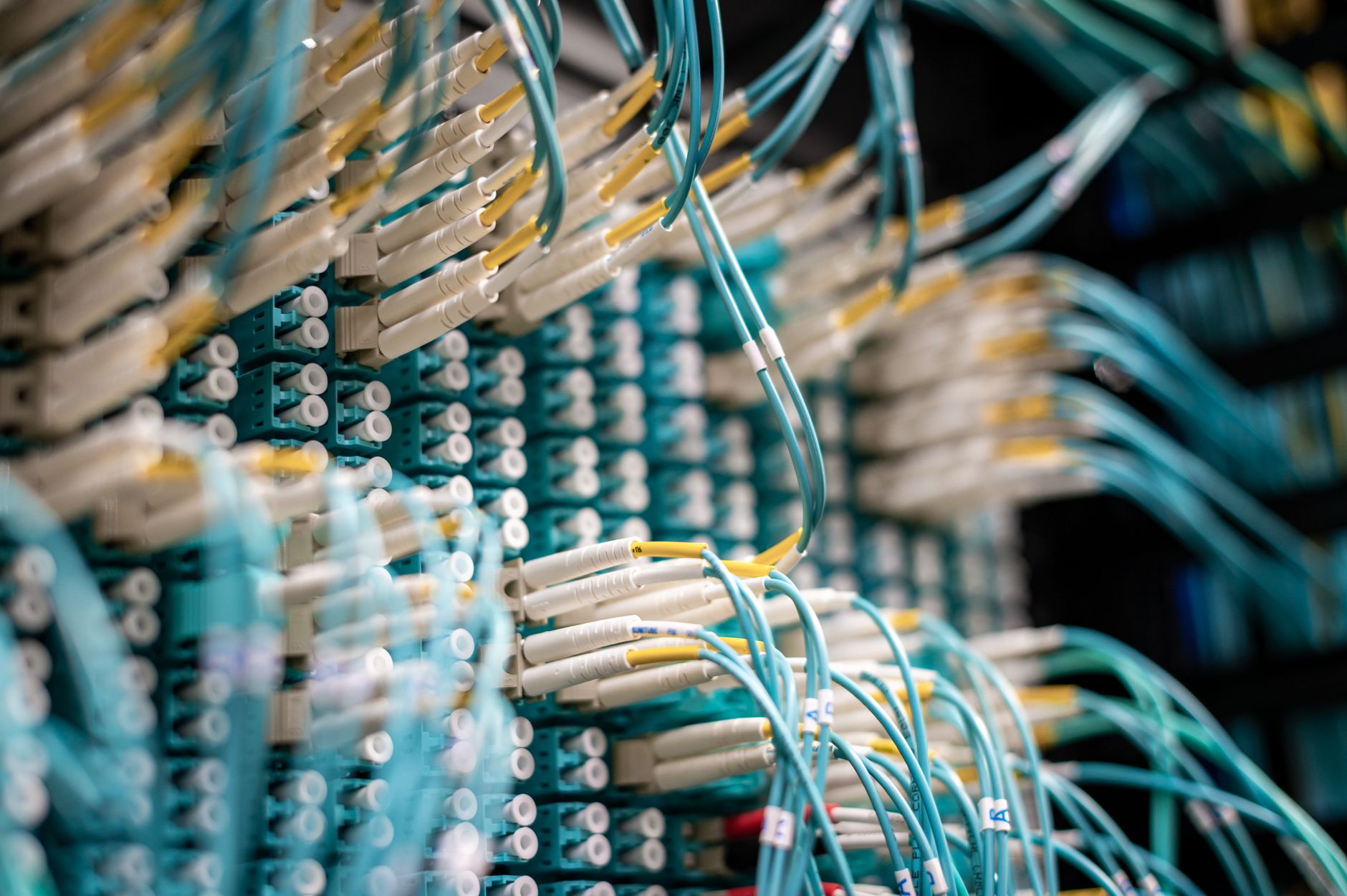
Photo by Brett Sayles on Pexels
The AI Traffic Revolution: Why Traditional Network Models Are Breaking Down
For years, network architects designed optical infrastructure around a relatively predictable paradigm: data flows from users to centralized cloud servers and back. North-south traffic — the kind that moves between end users and data centers — was the dominant concern, and networks were optimized accordingly. Then came generative AI, and with it, a seismic shift that is forcing the entire optical networking industry back to the drawing board.
AI training and inference workloads don’t behave like conventional cloud applications. They generate enormous volumes of east-west traffic — data moving laterally between servers, GPUs, and storage nodes within and across data centers — often at a scale and synchronization level that would have seemed implausible just five years ago. Training a large language model, for instance, requires thousands of GPUs to exchange gradient updates simultaneously, producing traffic bursts that can saturate even well-provisioned optical links in milliseconds.
The implications for network operators and equipment vendors are profound. Optical networks that were purpose-built for cloud-era workloads are increasingly inadequate, and the industry is scrambling to develop architectures that can keep pace with AI’s insatiable appetite for bandwidth, low latency, and deterministic performance.
East-West Dominance and the Synchronization Problem
One of the most challenging aspects of AI-driven traffic is the requirement for tight synchronization across distributed compute resources. In AI training clusters, all-reduce operations — where GPU nodes must collectively share and aggregate model parameters — require that data arrive within extremely narrow timing windows. A single slow link can stall an entire training run, making tail latency as critical as average throughput.
This places extraordinary pressure on optical transport layers. Traditional wavelength-division multiplexing (WDM) systems were optimized for high-throughput, long-haul transmission, not the microsecond-level consistency that AI workloads demand. Modern hyperscale operators are increasingly turning to solutions like coherent pluggable optics — particularly 400G ZR and 400G ZR+ modules — that bring high-capacity coherent transmission directly into switches and routers, reducing hop counts and eliminating latency-inducing intermediate transponders.
Beyond pluggables, operators are evaluating next-generation architectures including ultra-low-latency ROADM (Reconfigurable Optical Add-Drop Multiplexer) configurations and optical circuit switching, which can provide dedicated, interference-free paths for latency-sensitive AI traffic flows in ways that traditional packet networks cannot.
Capacity at Hyperscale: The Push Toward 800G and Beyond
Bandwidth demand from AI infrastructure is growing at a rate that is outpacing even the most aggressive forecasts from just a few years ago. Hyperscale operators — including the major cloud providers building out their AI supercomputing clusters — are pushing optical vendors to accelerate roadmaps for 800G and even 1.6T per-wavelength transmission systems.
Companies like Ciena, Infinera, Nokia, and Huawei are all racing to commercialize 800G coherent solutions, leveraging advances in digital signal processing (DSP) chips, advanced modulation formats, and high-bandwidth photonic integrated circuits (PICs). The transition to 800G isn’t merely about raw capacity — it also improves spectral efficiency, reduces power consumption per bit, and simplifies network management by consolidating traffic onto fewer wavelengths.
Meanwhile, silicon photonics is emerging as a critical enabling technology, promising to dramatically reduce the cost and power footprint of high-speed optical components. As AI data centers scale to tens of thousands of interconnected GPUs, even modest per-port power savings translate into meaningful reductions in total infrastructure costs and energy consumption.
The Rise of AI-Optimized Network Fabrics
Beyond raw capacity upgrades, the industry is rethinking network topology itself. Traditional three-tier data center architectures — with core, aggregation, and access layers — introduce latency and complexity that AI workloads cannot tolerate. Flat, high-radix network fabrics built around optical interconnects are gaining traction, enabling any-to-any GPU connectivity with minimal hops and consistent bandwidth guarantees.
This is driving interest in technologies like optical bypass switching, where traffic can be routed entirely in the optical domain without electrical regeneration, and software-defined optical networking (SDON), which allows network resources to be dynamically allocated in response to the bursty, unpredictable demands of AI job schedulers.
Telecom carriers are also taking note. As AI inference workloads push out from centralized hyperscale facilities toward distributed edge deployments — closer to end users for latency-sensitive applications — metro optical networks will need to evolve to support the same demanding traffic profiles currently seen only inside the largest data centers.
Industry Outlook: An Optical Renaissance
The optical networking sector, which experienced significant consolidation and commoditization pressure during the post-dot-com era, is experiencing a renaissance driven almost entirely by AI. Market analysts project that global optical networking revenues will surpass $25 billion by 2027, with hyperscale and AI-related investments accounting for a growing share of that figure.
For telecom operators and network infrastructure providers, the message is clear: the AI era demands optical networks that are faster, smarter, more deterministic, and fundamentally more dynamic than what exists today. Those who invest in next-generation coherent optics, programmable optical fabrics, and AI-aware network management platforms will be best positioned to serve the hyperscale operators and enterprises that are rapidly making AI a core part of their digital infrastructure. The optical layer, long considered a stable and mature domain, is once again at the frontier of network innovation.
