
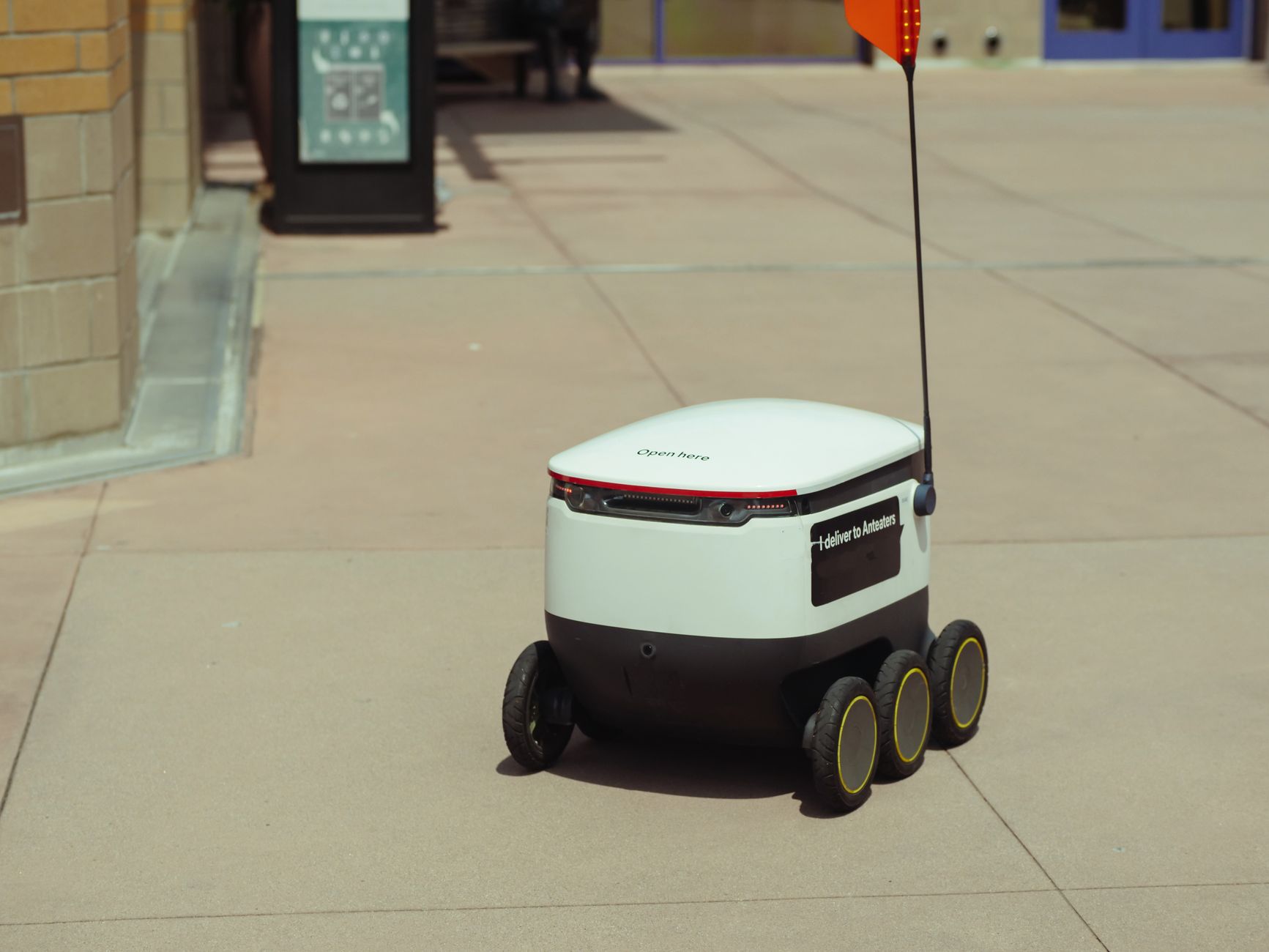
Photo by Kindel Media on Pexels
The Next Frontier: When AI Steps Into the Physical World
For years, telecom network evolution has been framed around speed — faster downloads, more bandwidth, broader coverage. But a seismic shift in perspective is gaining momentum in boardrooms and engineering labs alike. Samsung Electronics, one of the world’s leading network infrastructure vendors, is now arguing that the rise of physical AI — artificial intelligence embedded in robots, autonomous vehicles, industrial machinery, and real-world sensing systems — will force a fundamental rethinking of what networks are actually for.
Jungchul Kim, head of product strategy at Samsung’s Networks Business division, recently articulated the challenge bluntly: physical AI applications will place demands on networks that go well beyond raw throughput. We’re talking about ultra-low latency measured in single-digit milliseconds, carrier-grade reliability approaching five-nines uptime, and — critically — consistency. Not peak performance, but guaranteed, deterministic performance. That’s a very different engineering problem.
What Exactly Is Physical AI — And Why Should Telecom Care?
Physical AI refers to the deployment of AI-driven intelligence in systems that interact directly with the physical environment. Think surgical robots performing minimally invasive procedures, autonomous warehouse logistics platforms coordinating hundreds of mobile units, self-driving vehicles navigating complex urban corridors, or smart manufacturing lines where machine vision and real-time decision-making replace human oversight. Unlike cloud-based AI that processes data at leisure, physical AI systems must sense, decide, and act in real time — with failure carrying real-world consequences.
For telecom operators and vendors, this distinction is everything. A video streaming service can tolerate a buffering hiccup. A robotic surgical arm or an autonomous heavy vehicle cannot. The network, in these scenarios, becomes part of the machine’s nervous system — and it must perform accordingly.
The Latency and Reliability Equation
Current 5G networks, particularly in their standalone (SA) configuration with network slicing capabilities, have made significant strides toward meeting demanding quality-of-service (QoS) requirements. Ultra-Reliable Low Latency Communications (URLLC), one of the three core 5G use-case pillars defined by 3GPP, was specifically designed with industrial and mission-critical applications in mind, targeting latencies under 1 millisecond and reliability of 99.9999%.
However, Samsung’s perspective highlights a gap between what 5G URLLC promises in specification sheets and what physical AI applications will actually require at scale. The challenge isn’t just meeting a latency threshold in optimal conditions — it’s delivering that performance consistently across dense deployments, mobile edge scenarios, and heterogeneous network environments. Jitter, the variance in latency rather than absolute latency itself, becomes a critical parameter when AI inference loops depend on clockwork-precise sensor feedback.
Edge Computing: The Network’s Answer to Physical AI
The logical response from the network architecture standpoint is aggressive edge computing deployment. By pushing AI inference workloads — and even model execution — closer to endpoints, operators can dramatically reduce round-trip latency to core data centers. Multi-access Edge Computing (MEC), long discussed as a 5G differentiator, finally has a compelling use case ecosystem in physical AI applications.
Samsung is not alone in recognizing this. Ericsson, Nokia, and a growing cohort of hyperscale cloud providers including AWS (with its Wavelength platform) and Microsoft (Azure Edge Zones) have been positioning edge infrastructure as the bridge between raw network connectivity and application-layer intelligence. The emerging consensus is that physical AI workloads will require a tiered compute architecture — on-device inference for the most time-sensitive decisions, edge nodes for slightly more complex processing, and cloud for training and model updates.
The Road to 6G Runs Through Physical AI
Perhaps the most significant implication of Samsung’s position is what it signals about the trajectory toward 6G. While commercial 6G deployments remain years away — most industry timelines point to 2030 and beyond — the physical AI imperative is actively shaping 6G research agendas today. Samsung’s own 6G white papers have emphasized native AI integration into the radio access network (RAN) itself, not merely as an optimization tool but as a core architectural component.
6G research frameworks from organizations like the ITU, ETSI, and various national spectrum agencies are already incorporating requirements that look tailor-made for physical AI: terahertz (THz) band communications for extreme throughput, sub-millisecond air interface latency, integrated sensing and communication (ISAC) capabilities, and network-level AI orchestration. The physical AI use case isn’t just a 6G talking point — it may well be the primary justification for 6G’s existence as a distinct generational leap rather than an incremental 5G upgrade.
Operator Implications: Infrastructure Investment and Business Model Evolution
For mobile network operators (MNOs), the physical AI era presents both a significant capital challenge and a revenue opportunity. Meeting the deterministic performance requirements of industrial AI clients will likely require densification of small cell deployments, dedicated network slice provisioning with contractual SLA guarantees, and edge compute infrastructure investment that extends well beyond traditional RAN capex models.
The business model shift is equally profound. Selling gigabytes of data to consumers is a commodity play. Selling guaranteed, mission-critical network performance to industrial and enterprise physical AI customers — with liability and SLA accountability baked in — is a fundamentally higher-value proposition, potentially transforming operators from connectivity pipes into essential industrial infrastructure partners.
Industry Outlook: Connectivity as a Competitive Differentiator for AI
Samsung’s framing of physical AI as a network demand driver reflects a broader industry maturation. As AI becomes ambient — woven into physical infrastructure rather than confined to software applications — the network layer becomes inseparable from AI system design. Telecom vendors and operators who recognize this early, and build the technical capability and commercial frameworks to serve physical AI clients, stand to define the next decade of network value creation.
The conversation is shifting from “how fast is your network?” to “how reliably intelligent can your network make physical systems?” That’s a question the telecom industry is only beginning to learn how to answer — and the race to do so is already underway.
