
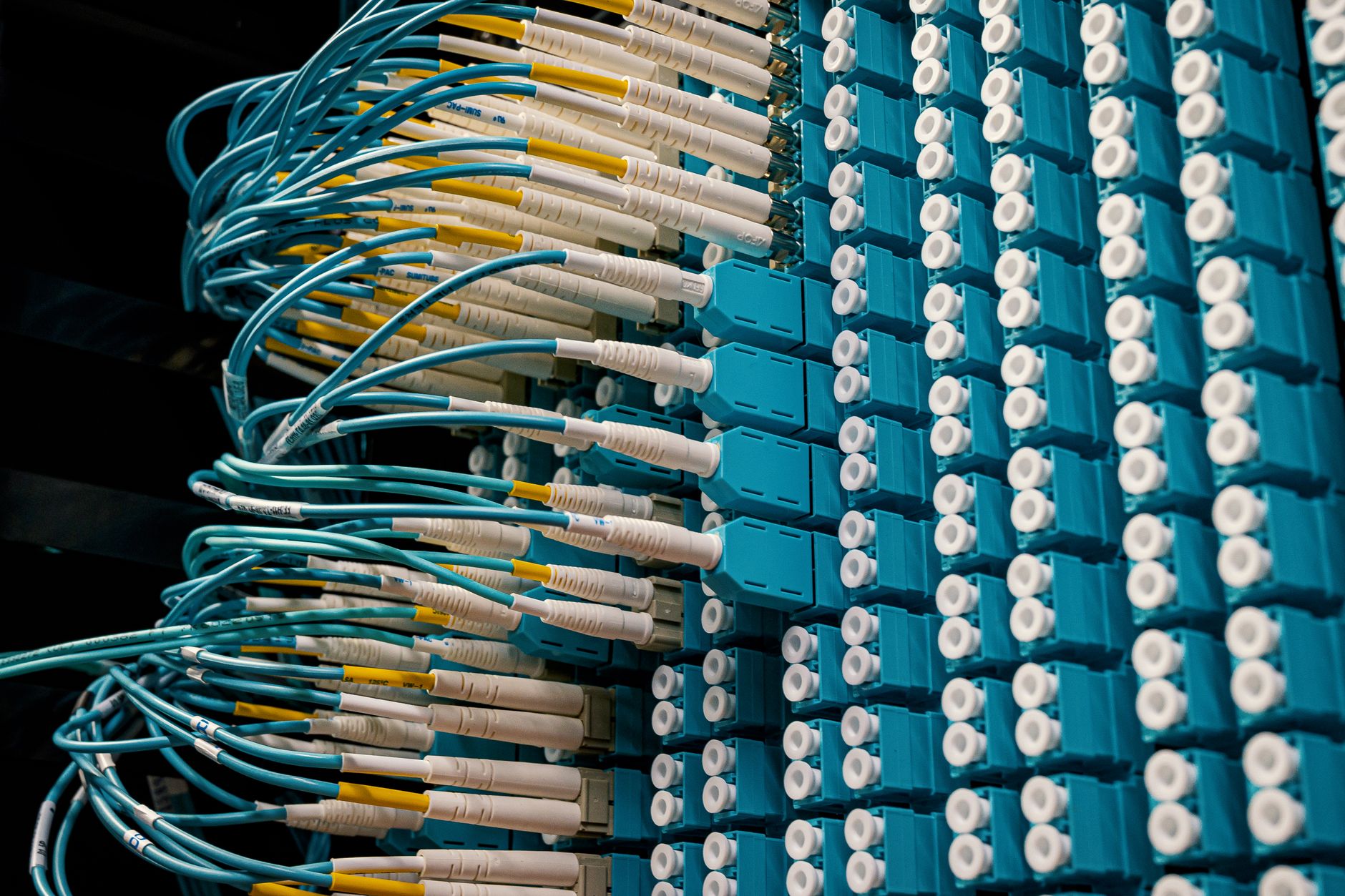
Photo by Brett Sayles on Pexels
The Optical Revolution Powering the AI Era
Artificial intelligence is no longer just a software story — it’s rapidly becoming one of the most demanding infrastructure challenges the telecommunications and data center industries have ever faced. At the center of this transformation, optical networking is emerging as the indispensable backbone that will determine whether global AI ambitions succeed or stall under the weight of their own data demands.
Bruno Berti, Senior Vice President of Global Product Management at NTT Global Data Centers, recently shed light on this critical intersection, emphasizing that optical technology is rapidly transitioning from a supporting role to a starring one in the architecture of modern AI infrastructure. Yet, Berti also offered a sobering counterpoint: no matter how sophisticated optical technology becomes, it will not single-handedly resolve the insatiable appetite for fiber that AI traffic is generating.
Why Optical Networks Are Central to AI Infrastructure
To understand why optical networking has become so strategically vital, it helps to consider what AI workloads actually demand from a network. Training large language models (LLMs) and running inference at scale require massive, low-latency data transfers between GPU clusters, storage systems, and cooling infrastructure — often moving petabytes of data within and between data center facilities in very short windows.
Traditional copper-based interconnects, even high-speed Ethernet variants, struggle to keep pace with the bandwidth density and energy efficiency requirements of hyperscale AI environments. Optical networking, by contrast, can deliver terabit-per-second throughput over a single fiber strand using technologies like dense wavelength division multiplexing (DWDM), coherent optics, and silicon photonics — all while consuming significantly less power per bit transmitted.
Silicon Photonics and Co-Packaged Optics
Two of the most consequential emerging optical technologies for AI infrastructure are silicon photonics and co-packaged optics (CPO). Silicon photonics integrates optical components directly onto standard silicon chips, dramatically reducing the cost and size of optical transceivers while improving performance. Co-packaged optics, meanwhile, places optical engines directly alongside switch ASICs, slashing the distance electrical signals must travel and dramatically cutting power consumption — a critical consideration as AI data centers push power densities to unprecedented levels.
Major switch and networking vendors, including Broadcom, Marvell, and Intel, are racing to commercialize CPO solutions, with widespread deployment expected to accelerate through 2025 and 2026. For data center operators like NTT, these innovations represent a fundamental architectural shift rather than an incremental upgrade.
The Fiber Demand Problem Optical Technology Can’t Solve Alone
Despite the transformative capabilities of next-generation optical systems, NTT’s Berti delivered a message that resonates strongly across the broader telecom industry: optical innovation is not a silver bullet for capacity constraints. Even as spectral efficiency improves — allowing more data to traverse existing fiber strands — the sheer volume of AI-generated traffic is growing faster than any single technology can accommodate.
AI model training, real-time inference serving, federated learning across distributed data centers, and the integration of AI into enterprise and consumer applications are collectively driving traffic growth that industry analysts estimate could increase backbone network demand by 40 to 60 percent annually through the remainder of the decade. That trajectory makes physical fiber deployment not just necessary but urgent.
The Global Fiber Gap
This creates what many industry observers are calling a “fiber gap” — a growing mismatch between available fiber infrastructure and the capacity required to support AI-driven digital economies. Countries and regions with underdeveloped fiber networks face the very real risk of being locked out of the AI economy not due to a lack of computing resources, but simply because their network fabric cannot carry the load.
In the United States, ongoing federal broadband funding initiatives like the BEAD program are directing billions toward expanding fiber access — but much of that investment targets last-mile residential connectivity rather than the high-capacity metro and long-haul routes that AI data center interconnection demands. Bridging that gap will require coordinated investment from both the public and private sectors.
NTT’s Strategic Position in the AI Infrastructure Race
NTT Global Data Centers, part of the broader NTT Group ecosystem, is among a handful of global operators uniquely positioned to address the AI infrastructure challenge at scale. With a presence spanning North America, Europe, Asia-Pacific, and beyond, NTT operates a vertically integrated stack that includes submarine cable systems, terrestrial fiber networks, and hyperscale data center campuses — giving the company an end-to-end view of where optical networking bottlenecks are emerging and how to resolve them.
The company’s push to make optical networks central to AI infrastructure is also aligned with growing customer demand. Hyperscalers, cloud providers, and enterprise AI adopters are all pressuring their data center and network partners to deliver higher bandwidth, lower latency, and greater reliability — with power efficiency increasingly factored into procurement decisions as sustainability commitments tighten.
Industry Outlook: Optical and Fiber Must Scale Together
The consensus forming across the telecom and data center sectors is clear: optical technology and physical fiber deployment are not competing priorities — they are complementary imperatives. Advanced coherent optical systems can squeeze more capacity from existing fiber routes, buying critical time, but the long-term scalability of AI infrastructure ultimately depends on laying more glass in the ground and across the ocean floor.
As AI continues to reshape every sector of the global economy, the networks that carry its data will be as consequential as the models themselves. For operators like NTT, getting optical infrastructure right isn’t just a technical challenge — it’s a strategic imperative that will define competitive positioning for the next decade and beyond.
