
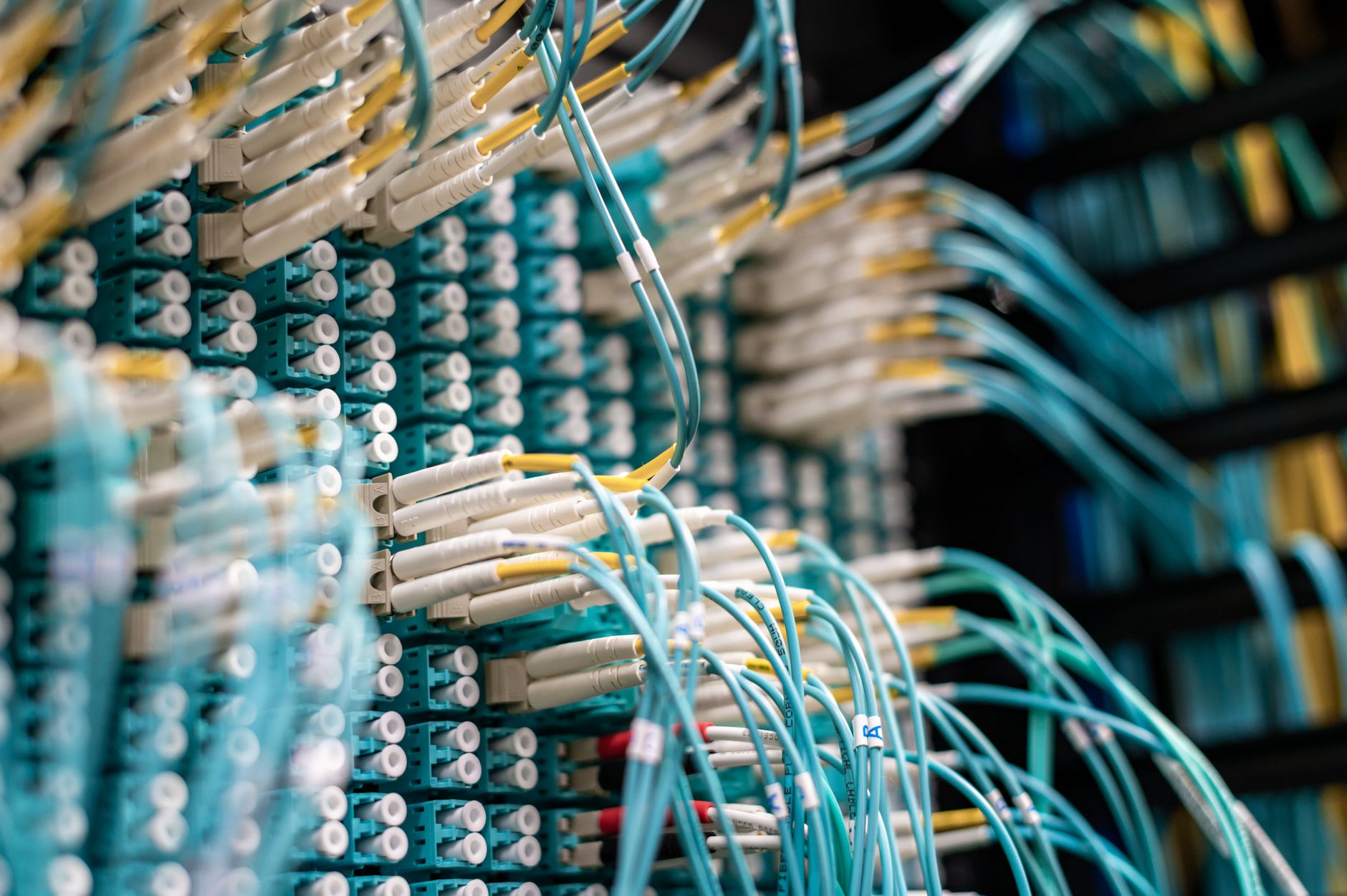
Photo by Brett Sayles on Pexels
The Satellite Threat Is Real — But Don’t Sleep on the Infrastructure Race
SpaceX’s Starlink has become the name that keeps telecom executives up at night. With over 6,000 satellites now in low Earth orbit (LEO) and regulatory approvals accumulating at a pace that would have seemed impossible just five years ago, the service is no longer a niche solution for rural ranchers and remote research stations. It’s a legitimate broadband competitor — and it’s coming for the mass market. But here’s the thing: while the satellite storyline dominates headlines, the more consequential battle for the future of connectivity is still being waged underground, along utility poles, and inside network operations centers where traditional carriers are making massive bets on infrastructure scale.
The convergence of Starlink’s expansion, Vodafone’s merger-driven consolidation savings, and AT&T’s aggressive fiber rollout tells a more nuanced story than a simple David-vs-Goliath narrative. What’s actually happening is a comprehensive reshaping of the global telecoms market — one where scale, density, and infrastructure depth will ultimately determine survival.
Starlink’s Regulatory Momentum: A Global Footprint Taking Shape
Starlink’s regulatory wins are piling up with remarkable speed. The service has secured operating approvals in over 70 countries, with recent clearances spanning markets from Southeast Asia to sub-Saharan Africa. The significance here isn’t just geographic reach — it’s the signal these approvals send to investors, enterprise customers, and governments about satellite broadband’s legitimacy as critical infrastructure.
From a technical standpoint, Starlink’s Gen2 satellites — deployed on SpaceX’s Falcon 9 and increasingly on Starship — offer substantially improved throughput, with the company targeting peak speeds exceeding 1 Gbps for direct-to-cell applications. Meanwhile, Starlink’s partnerships with mobile network operators (MNOs), including T-Mobile in the U.S. and various carriers internationally, for direct-to-device (D2D) connectivity are blurring the line between satellite and terrestrial networks in ways that would have seemed like science fiction a decade ago.
But latency remains a real constraint. Even with LEO advantages — typically 20-40ms round-trip compared to 600ms+ for geostationary satellites — Starlink still struggles to match fiber’s sub-10ms performance for latency-sensitive applications like cloud gaming, real-time financial transactions, and enterprise communications. This is where traditional carriers retain a structural advantage, provided they actually build the infrastructure to capitalize on it.
AT&T’s Fiber Push: Betting Big on the Last Mile
AT&T has made its position clear: fiber is the answer to long-term broadband competitiveness. The carrier has been expanding its fiber footprint at an aggressive clip, targeting 30 million-plus locations passed by fiber by the end of 2025. AT&T Fiber is now one of the fastest-growing broadband products in the U.S., adding subscribers even as its legacy DSL and copper infrastructure fades into obsolescence.
The economics make sense. Once fiber is deployed, the cost to add incremental subscribers drops dramatically, and the product — symmetrical gigabit speeds with low latency — is genuinely superior to anything Starlink can currently offer in dense or suburban environments. AT&T is also leveraging its fiber infrastructure to backhaul its own 5G network, creating a virtuous cycle where wireline and wireless investments reinforce each other.
The key risk? Execution speed. BEAD program funding from the U.S. government is slowly unlocking capital for rural broadband build-outs, but regulatory and permitting delays continue to hamper deployment timelines. In the windows where AT&T or any incumbent hasn’t yet laid fiber, Starlink is perfectly positioned to grab — and retain — customers.
Vodafone’s Merger Math: Scale as a Survival Strategy
Across the Atlantic, Vodafone’s consolidation strategy reflects a different but equally urgent response to competitive pressure. The proposed merger with Three UK — pending regulatory approval — is projected to generate hundreds of millions in annual cost savings through network sharing, spectrum rationalization, and operational efficiencies. The logic is straightforward: smaller operators running parallel infrastructure cannot sustainably invest in 5G densification and fiber backhaul while also competing on price against well-capitalized insurgents.
This merger-driven consolidation trend is visible across Europe, where regulators are slowly — if grudgingly — beginning to accept that forcing too many competitors into a market results in underinvestment, not consumer benefit. Scale enables the capital expenditure required to build the dense, high-capacity networks that 5G’s full potential demands.
The Real Lesson: Infrastructure Build-Out Cannot Be an Afterthought
The satellite vs. terrestrial framing is ultimately a false binary. Starlink and LEO broadband will be genuinely transformative for underserved geographies, maritime, aviation, and enterprise backup scenarios. But for the majority of global broadband users in suburban and urban environments, the quality ceiling of fiber and dense 5G remains well above what satellites can deliver today.
The danger for incumbent telcos isn’t that Starlink will win everywhere — it won’t. The danger is complacency. Every quarter a carrier delays its fiber rollout or 5G densification is a quarter Starlink has to plant its flag and build customer loyalty in markets that could have been captured through infrastructure investment.
Industry Outlook: The Infrastructure Imperative
The telecoms market is being reshaped around three interlocking forces: satellite competition driving urgency, consolidation driving scale, and government funding accelerating deployment. Carriers that treat infrastructure investment as a cost to be minimized rather than a competitive moat to be built will find themselves squeezed from above by Starlink and below by fiber-first challengers.
The winners of the next decade of connectivity won’t necessarily be the ones who launched the most satellites or completed the most mergers. They’ll be the operators who recognized that the infrastructure build-out — unsexy, expensive, and operationally complex as it is — remains the foundational bet that everything else depends on. Starlink may be on your tail, but the race is still very much run on the ground.
