
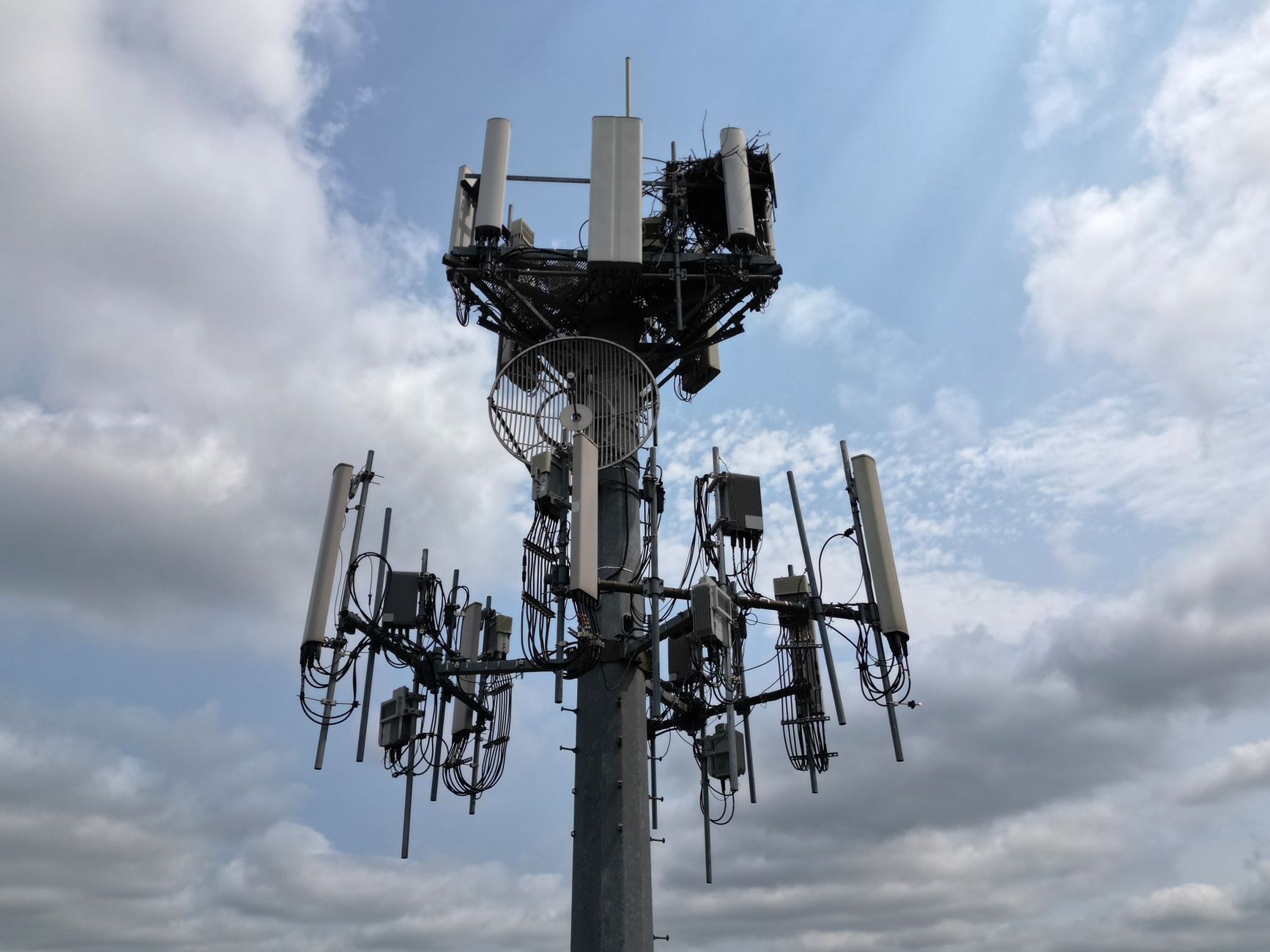
Photo by Giant Asparagus on Pexels
5G Infrastructure Gets a New Mission: Spotting Drones Without Radar
In a development that could reshape how governments, airports, and enterprises think about airspace security, AT&T and Ericsson have jointly demonstrated a network sensing system capable of detecting drones using nothing more than existing 5G towers. The landmark demo, conducted at an AT&T facility, showed the technology successfully tracking an unconnected drone — meaning the aerial device had no active SIM card or cellular radio of its own — purely by analyzing disturbances in the 5G signal environment.
The implications are profound. Rather than deploying costly dedicated radar systems or specialized sensor arrays, this approach essentially turns the billions of dollars already invested in 5G infrastructure into a passive surveillance and detection layer — one that could operate continuously without additional spectrum or hardware footprints.
How Network Sensing Actually Works
At its core, network sensing — sometimes referred to as Integrated Sensing and Communication (ISAC) — leverages the radio signals that 5G base stations already broadcast to communicate with devices. When an object like a drone moves through the coverage area, it subtly disrupts, reflects, or scatters those radio waves. By applying advanced signal processing algorithms and machine learning models, the network can analyze these disturbances and infer the presence, location, size, and movement trajectory of an object.
This is fundamentally different from traditional radar, which requires dedicated transmission pulses and receivers tuned specifically for detection tasks. With ISAC, the same 5G millimeter wave (mmWave) or sub-6 GHz signal that’s delivering gigabit data speeds to your smartphone is simultaneously serving as a sensing medium — a two-for-one use of spectrum and infrastructure that network engineers have long theorized about but are only now beginning to operationalize at scale.
The Role of Ericsson’s Radio Technology
Ericsson’s contribution centers on its advanced antenna systems and baseband processing capabilities. The company has been investing heavily in ISAC research as part of its broader 5G Advanced and pre-6G roadmap. Its massive MIMO antenna arrays — already deployed across AT&T’s network — are particularly well-suited for sensing applications because they offer highly directional beamforming, which can be steered and analyzed to detect spatial anomalies with fine-grained precision.
The software layer matters just as much as the hardware. Ericsson’s processing stack must distinguish between a drone, a bird, an aircraft, or simple environmental interference like wind-blown debris. That level of classification sophistication requires significant training data and AI-driven filtering — an area where the companies have clearly invested considerable R&D resources ahead of this demonstration.
Why Drone Detection Matters Right Now
The timing of this announcement is no accident. The proliferation of commercial drones has created serious headaches for airport authorities, military installations, critical infrastructure operators, and large public venues. The FAA reported thousands of drone-related incidents in recent years, and counter-drone technology has become a fast-growing market segment. According to industry analysts, the global counter-drone market is projected to exceed $10 billion by the early 2030s.
Current detection solutions — including dedicated radar, acoustic sensors, RF scanners, and optical cameras — are expensive to deploy, require specialized maintenance, and often leave coverage gaps. A solution that piggybacks on existing cellular infrastructure could dramatically reduce the cost and complexity of wide-area drone monitoring, particularly in urban environments where 5G tower density is already high.
Beyond Drones: A Platform for Broader Sensing Applications
While the drone detection use case is the headline grabber, industry insiders are quick to point out that network sensing as a capability is far more versatile. The same underlying technology could be applied to traffic monitoring, pedestrian flow analysis, intrusion detection at critical facilities, weather and environmental sensing, and even healthcare applications like fall detection in assisted living environments.
This positions ISAC not just as a security tool, but as a potential new revenue stream for carriers like AT&T. Selling sensing-as-a-service to municipalities, logistics companies, event organizers, and government agencies could open entirely new B2B markets — a critical growth vector as traditional voice and data ARPU growth continues to plateau.
Regulatory and Privacy Considerations on the Horizon
Not everyone will greet this capability with uncomplicated enthusiasm. The ability to passively monitor physical space using ubiquitous cellular towers raises legitimate questions about privacy, data governance, and regulatory oversight. Who owns the sensing data? How long is it retained? Can law enforcement access it without a warrant? These are questions that policymakers, civil liberties advocates, and the FCC will inevitably need to address as the technology matures and commercial deployments become realistic.
AT&T and Ericsson will need to engage proactively with these concerns if they want to avoid the kind of regulatory friction that has slowed other promising telecom innovations.
Industry Outlook: ISAC as a 5G Advanced and 6G Cornerstone
This demonstration arrives at a moment when the global telecom industry is actively defining what comes after basic 5G connectivity. The 3GPP standards body has already begun incorporating sensing capabilities into its 5G Advanced specifications (Release 18 and beyond), and ISAC is widely expected to be a foundational pillar of 6G architecture. China’s major carriers and equipment vendors have also been aggressively pursuing ISAC research, making this a competitive frontier as much as a technical one.
For AT&T, showcasing a real-world, working demo of network sensing — rather than just a whitepaper concept — is a meaningful signal to enterprise customers, government partners, and investors that its 5G infrastructure investment is capable of delivering value well beyond traditional connectivity. For Ericsson, it reinforces the company’s narrative that its radio systems are future-proof platforms, not just connectivity pipes.
The 5G tower was always more powerful than it looked. We may be just beginning to understand its full potential.
